
Introduction
The UEFA Champions League has long been a stage for the world’s elite football clubs, where history, skill, and tactical intelligence converge in high-stakes competition. The recent Bodø/Glimt vs Inter match captured global attention not only because of the David-versus-Goliath narrative but because it defied expectations in dramatic fashion. For a club from Norway’s Arctic Circle to host and dominate a heavyweight like Inter Milan was a historic moment for European football. The 3–1 result in favor of Bodø/Glimt in the first leg of this tie reverberated across sports media, social platforms, and football circles worldwide, symbolizing the growing competitiveness of emerging clubs on the European stage.
This article provides a comprehensive look at the Bodø/Glimt vs Inter clash, exploring the clubs’ history, the lead-up to the match, tactical analyses, player performances, and the broader implications of this remarkable encounter.
Bodø/Glimt: From Modest Beginnings to European Contenders
The Rise of a Northern Norwegian Powerhouse
Founded in 1916, Bodø/Glimt spent much of its early history outside the limelight of top European football. Traditionally a mid-tier Norwegian club, the team’s profile began to rise significantly in the last decade. With a focus on youth development, tactical innovation, and attacking football, Bodø/Glimt gradually carved out a reputation as one of Norway’s most exciting teams. Their rise to the UEFA Champions League knockout phase in 2025–26 was a testament to years of strategic planning and investment in both infrastructure and player development.
The club’s philosophy under head coach Kjetil Knutsen emphasized possession-based football, fast transitions, and high pressing. This approach allowed Bodø/Glimt to compete effectively against more resourceful teams, demonstrating that tactical discipline and cohesion could offset differences in squad experience and reputation.
European Journey Prior to Inter
Bodø/Glimt’s route to facing Inter Milan was already historic. In the group stage of the Champions League, they had faced clubs like Manchester City, Atlético Madrid, and Ajax, producing surprising results. The team’s ability to execute disciplined defensive schemes, combined with incisive attacking transitions, allowed them to secure victories that few analysts had predicted. Their performance set the stage for the Bodø/Glimt vs Inter clash as a match with genuine potential to shift perceptions about Norwegian football on the continental stage.
Inter Milan: The Italian Giants
A Legacy of European Success
By contrast, Inter Milan is one of Europe’s most storied football institutions. Founded in 1908, the club has claimed numerous Serie A titles, Coppa Italia victories, and multiple UEFA trophies, including Champions League triumphs. Inter brings to every European match a wealth of experience, a tradition of tactical sophistication, and a deep squad featuring some of the world’s best players.
Despite being favorites on paper, Inter faced challenges in the 2025–26 Champions League. A mixed performance in the group stage had raised questions about squad depth and consistency. Nevertheless, their pedigree and ability to perform in high-pressure situations made them a formidable opponent for any emerging club.
Tactical Approach
Inter’s traditional approach combines structured defense, patient build-up play, and swift exploitation of attacking opportunities. Under their coach, the team emphasizes disciplined defensive organization, fluid midfield control, and clinical finishing. In theory, this style is well-suited to counter Bodø/Glimt’s aggressive pressing, making the matchup both tactically intriguing and highly competitive.
Match Context: Bodø/Glimt vs Inter
Venue and Conditions
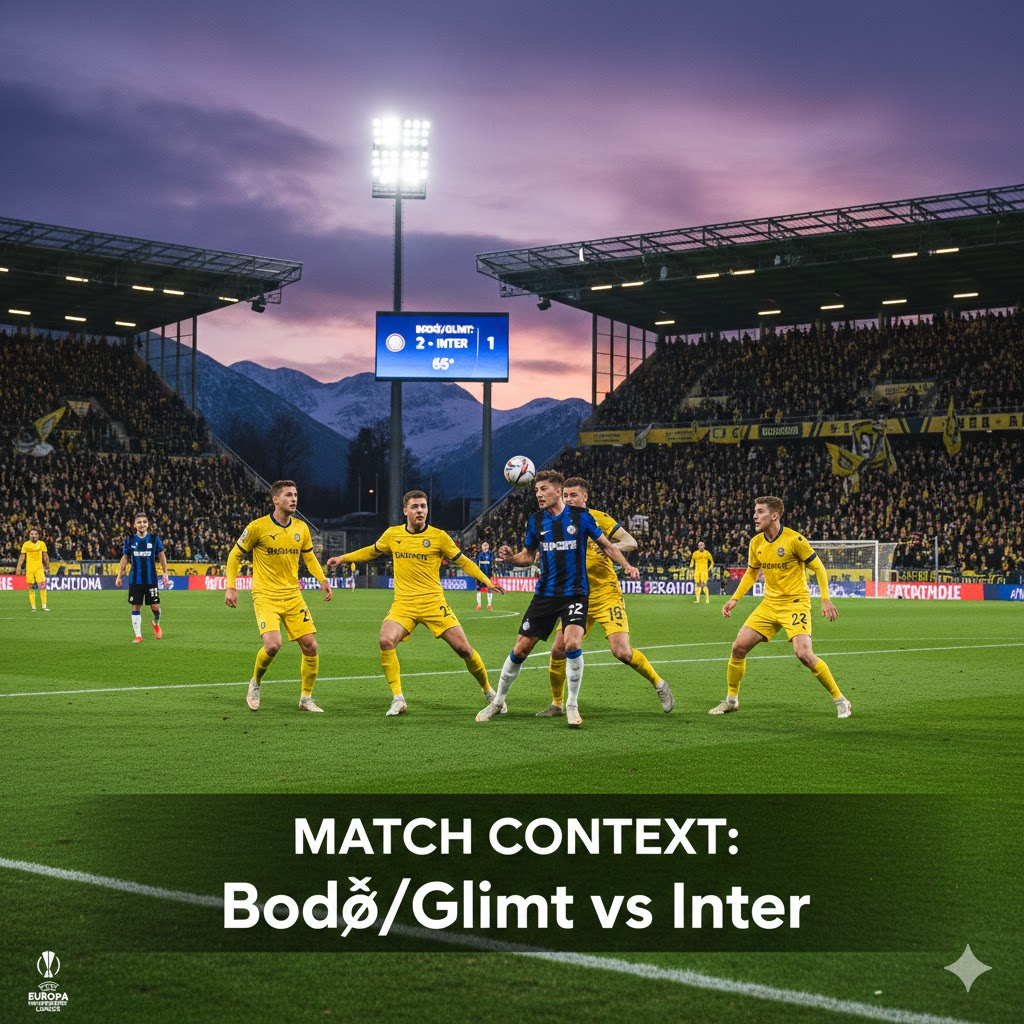
The first leg of the tie took place at Aspmyra Stadion in Bodø, a city known for its Arctic climate. The northern location presented unique challenges, including cold temperatures, snow, and high winds. Bodø/Glimt was accustomed to these conditions, giving them a subtle yet tangible home advantage. Inter, by contrast, had to adapt to both the environmental factors and the artificial pitch, a scenario rarely encountered in Serie A.
Match Build-Up
Leading into the game, analysts predicted a tactical battle. Inter was expected to dominate possession, test Bodø/Glimt’s defensive organization, and control the tempo. Bodø/Glimt, meanwhile, relied on counter-attacks, pressing in midfield, and exploiting transitions to create scoring opportunities. The narrative of Bodø/Glimt vs Inter thus centered on whether the Norwegian club could withstand pressure and capitalize on limited chances against one of Europe’s elite sides.
The Match: A Comprehensive Breakdown
First Half
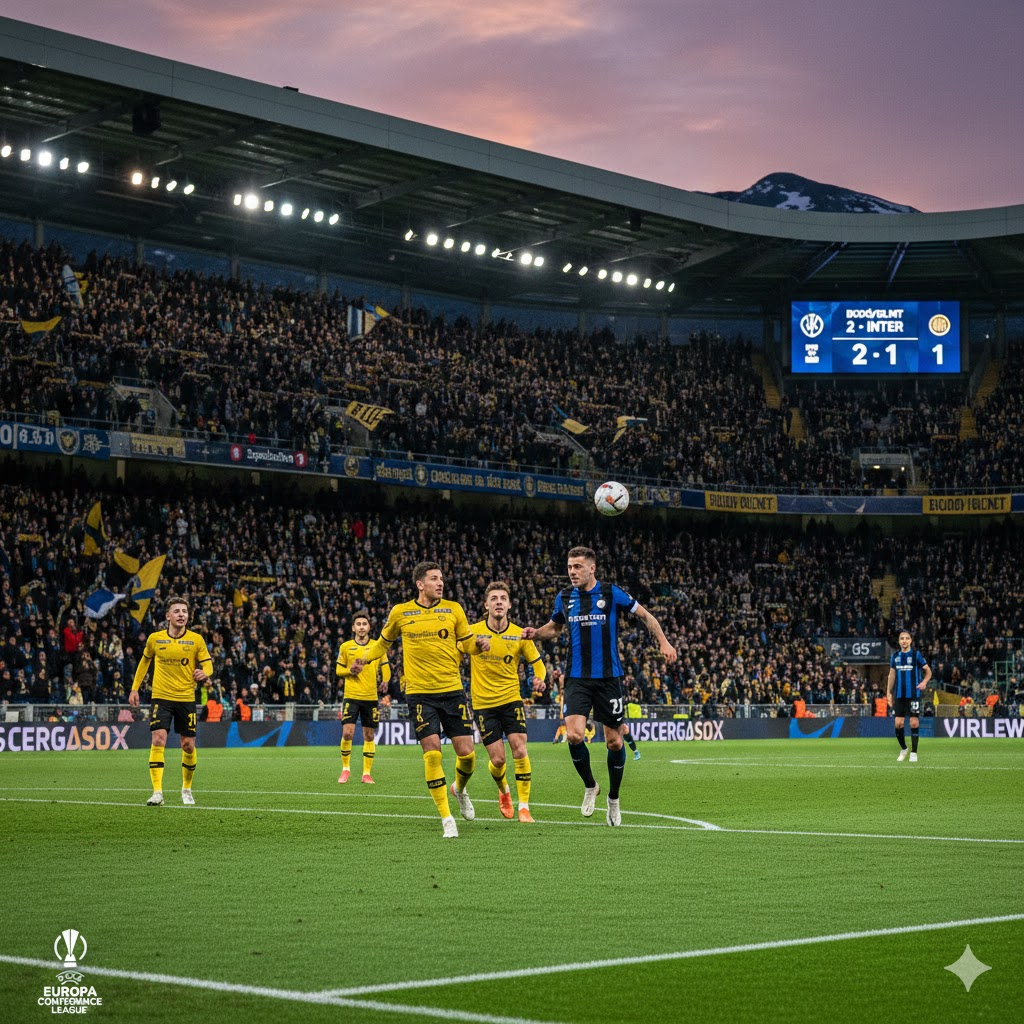
The match began with Inter attempting to assert control through possession, but Bodø/Glimt’s defensive organization proved resilient. In the 20th minute, Sondre Brunstad Fet broke the deadlock with a well-placed strike following a rapid transition. The goal energized the home team and unsettled Inter, forcing them to adjust their approach.
Inter responded with a goal before halftime, equalized by Francesco Pio Esposito, whose movement in the box demonstrated Inter’s attacking quality. Despite conceding early, Bodø/Glimt maintained composure and adhered to their game plan, ensuring the match remained balanced at 1–1 going into the break.
Second Half
The second half showcased Bodø/Glimt’s strategic execution and technical prowess. Early in the period, Jens Petter Hauge’s precise finish put Bodø/Glimt ahead, and shortly after, Kasper Høgh delivered a powerful strike to extend the lead to 3–1. These goals highlighted Bodø/Glimt’s efficiency in front of goal, contrasting with Inter’s struggles to convert possession into meaningful scoring opportunities.
Bodø/Glimt’s pressing and transitions disrupted Inter’s rhythm throughout the second half. By forcing mistakes in the midfield and exploiting open spaces behind Inter’s defense, the Norwegian side controlled the narrative and dictated play, a remarkable feat against such a storied opponent.
Key Tactical Observations
Several tactical elements defined the match:
- Effective Pressing: Bodø/Glimt’s high-intensity pressing limited Inter’s ability to build attacks from the back, forcing turnovers in dangerous areas.
- Efficient Finishing: While Inter created more chances overall, Bodø/Glimt converted their opportunities with clinical precision, underlining the importance of efficiency over volume in knockout matches.
- Home Advantage: Familiarity with the pitch, weather, and atmosphere played a critical role, allowing Bodø/Glimt to maintain composure under pressure and exploit Inter’s occasional indecision.
- Player Coordination: Bodø/Glimt’s attackers and midfielders maintained constant movement, creating passing lanes and stretching Inter’s defensive structure, resulting in two decisive second-half goals.
Player Performances

Bodø/Glimt Standouts
- Kasper Høgh: Scored a goal and assisted another, exhibiting composure, speed, and clinical finishing that unsettled Inter’s defenders.
- Sondre Brunstad Fet: Opened the scoring and contributed to offensive build-up, showcasing vision and intelligent positioning.
- Jens Petter Hauge: His second-half goal underscored his ability to exploit defensive gaps and finish under pressure.
Inter Milan Observations
- Yann Sommer: Faced relentless pressure, making key saves, but was unable to prevent two second-half goals.
- Francesco Pio Esposito: Displayed youthful promise by scoring Inter’s equalizer but struggled to influence the second half meaningfully.
- Defensive Line: Inter’s defenders, including Manuel Akanji and Francesco Acerbi, were repeatedly tested by Bodø/Glimt’s movement, revealing vulnerabilities in adapting to high-intensity pressing.
Implications of the Result
For Bodø/Glimt
The 3–1 home victory is historic. It marks the first time a Norwegian club has taken such a commanding lead against an Italian giant in a Champions League knockout round. The result elevates Bodø/Glimt’s status on the European stage, proving that strategic planning, tactical discipline, and mental resilience can bridge the gap between emerging and established clubs.
For Inter Milan
The loss puts Inter in a precarious position for the second leg. A two-goal deficit necessitates an aggressive approach at San Siro, which could expose defensive vulnerabilities. The match also serves as a wake-up call for the club to re-evaluate tactical approaches when facing highly organized, fast-transition teams.
For European Football
The Bodø/Glimt vs Inter encounter underscores a broader trend: smaller clubs, when strategically managed and tactically disciplined, can compete with traditional powerhouses. This result may influence future approaches by elite clubs when preparing for matches against less-heralded opponents, emphasizing adaptability and vigilance over assumed superiority.
Looking Ahead: The Second Leg
The return leg in Milan promises to be equally compelling. Inter will likely pursue an aggressive, high-press strategy to overturn the deficit, while Bodø/Glimt may focus on controlling tempo, exploiting counter-attacks, and maintaining defensive solidity. This scenario sets the stage for a high-stakes, tactically rich encounter that could define Bodø/Glimt’s European trajectory and challenge Inter’s resilience in the Champions League.
Read Also The Article: Qarabag FK vs Newcastle: An In-Depth Analysis of a Champions League Clash
Conclusion
The Bodø/Glimt vs Inter match stands as a landmark moment in modern European football. Bodø/Glimt’s 3–1 victory was not only a triumph on the scoreboard but a testament to strategy, preparation, and belief. The match demonstrated that rising clubs from non-traditional football nations could compete effectively with established giants when tactical intelligence, efficiency, and psychological resilience are maximized.
This clash will be remembered for years as a classic example of how underdogs can succeed on the grandest stage, reshaping perceptions and inspiring clubs across Europe. As both teams prepare for the second leg, the legacy of this first encounter continues to resonate, affirming that in football, preparation, adaptability, and courage often outweigh history and reputation.